

Relocating to the Philadelphia Suburbs:
The Complete 2026 Guide to Choosing the Right Community
Summary
Relocating to the Philadelphia suburbs is about far more than simply finding a house. It’s about finding a community that matches your lifestyle, commute, family goals, budget, and long-term plans. One of the biggest misconceptions among buyers relocating from New York City, Washington, D.C., New Jersey, or even Philadelphia itself is that the suburbs operate as one unified market. They don’t. Chester County, the Main Line, Bucks County, Montgomery County, Delaware County, and South Jersey each offer distinctly different lifestyles, housing stock, school districts, tax structures, and commuting patterns.
As a Realtor and attorney serving both Pennsylvania and New Jersey, I encourage buyers to begin with how they want to live rather than simply searching by ZIP code or price range. Once you identify the lifestyle you’re looking for, choosing the right town becomes significantly easier.
Table of Contents
- Why So Many Buyers Are Choosing the Philadelphia Suburbs
- Understanding the Philadelphia Suburbs
- Choosing a Lifestyle Before Choosing a House
- Understanding Commutes
- Schools, Taxes, and Monthly Budget
- Housing Styles Across the Region
- What Buyers Often Overlook
- The Biggest Mistakes Relocators Make
- Why Working With a Local Expert Matters
- Final Thoughts
⸻
Why So Many Buyers Are Choosing the Philadelphia Suburbs
For decades, the Philadelphia suburbs have been among the strongest residential real estate markets in the Northeast. They offer something that many metropolitan areas struggle to provide: genuine lifestyle diversity within a relatively compact geographic area.
Within forty-five minutes, you can transition from a vibrant downtown filled with restaurants and nightlife to rolling horse farms, historic villages, luxury estate neighborhoods, waterfront communities, or family-oriented suburban developments.
That flexibility attracts an incredibly diverse group of buyers. Some are leaving Manhattan or Brooklyn in search of more space. Others are relocating from Washington, D.C. because remote work has reduced the need for a daily commute. Some are moving from California or Texas after accepting positions with regional healthcare systems, pharmaceutical companies, universities, or Fortune 500 employers. Others simply want a better balance between work, family life, recreation, and affordability.
Unlike many metropolitan areas where nearly every suburb feels similar, the Philadelphia suburbs each have their own identity.
That identity is what should drive your search.
⸻
Understanding the Philadelphia Suburbs
One of the first things buyers notice is that people casually refer to “the suburbs” as though they’re one place.
They aren’t.
Instead, think of the region as several different collections of communities.
Chester County
Chester County offers some of the greatest lifestyle diversity in the region. Buyers can choose walkable downtowns like West Chester and Phoenixville, commuter-friendly communities like Exton and Malvern, luxury countryside estates around Chadds Ford and Unionville, or family-oriented suburban neighborhoods throughout East and West Goshen, Uwchlan, and West Whiteland.
It attracts buyers who value parks, trails, restaurants, breweries, outdoor recreation, and a slightly more relaxed pace without sacrificing convenience.
⸻
The Main Line
The Main Line is synonymous with historic architecture, mature neighborhoods, prestigious school districts, commuter rail access, and long-term stability.
Communities like Wayne, Ardmore, Bryn Mawr, Villanova, Haverford, Narberth, and Berwyn each offer slightly different versions of the Main Line experience.
For buyers relocating from larger cities, the Main Line often feels familiar because it combines walkability with suburban comfort.
⸻
Bucks County
Bucks County offers a blend of historic boroughs, river towns, family-oriented neighborhoods, and scenic countryside.
Communities like Doylestown, Newtown, Yardley, and New Hope each have distinct personalities.
Many buyers are surprised by how different Lower Bucks feels compared to Central Bucks or Upper Bucks. Commute patterns, housing styles, lot sizes, and lifestyle all change dramatically across the county.
⸻
Montgomery County
Montgomery County offers perhaps the greatest variety of housing and commuting options.
King of Prussia serves as one of the largest employment centers in Pennsylvania, while Blue Bell, Ambler, Conshohocken, Lansdale, Lower Gwynedd, and Collegeville all provide unique advantages depending on your priorities.
For buyers balancing suburban life with professional careers, Montgomery County frequently becomes one of the strongest options.
⸻
Delaware County
Often overlooked, Delaware County combines affordability, excellent transportation access, mature neighborhoods, and proximity to Philadelphia.
Media, Swarthmore, Springfield, and Newtown Square have become increasingly attractive to buyers looking for character and convenience.
⸻
South Jersey
Many buyers relocating from Pennsylvania initially overlook South Jersey.
That can be a mistake.
Communities like Haddonfield, Moorestown, Medford, Cherry Hill, and Collingswood offer excellent schools, charming downtowns, strong commuter access into Philadelphia, and beautiful neighborhoods.
For some buyers, New Jersey taxes are offset by lower purchase prices or easier commutes. Every situation is different.
⸻
Choose a Lifestyle Before Choosing a House
This is the single biggest piece of advice I give relocating buyers.
Don’t begin with the house.
Begin with your routine.
Ask yourself:
Where do I want to eat dinner on Friday night?
How often do I commute?
Do I want sidewalks?
How important is being able to walk for coffee?
Would I rather have acreage or neighbors?
Do I want an older historic home or newer construction?
How much driving am I comfortable doing every week?
These questions narrow your search dramatically.
Someone who loves breweries, restaurants, and weekend events may thrive in Phoenixville or West Chester.
Someone who wants elegant neighborhoods, commuter rail, and proximity to Philadelphia may prefer Wayne or Ardmore.
Someone seeking privacy, land, and scenic views may ultimately fall in love with Chadds Ford.
The right answer depends entirely on how you actually live.
⸻
Understanding Commutes
Commute planning is often where relocators make their first major mistake.
Many buyers assume that because two towns appear close on a map, they’ll have similar commute times.
In reality, rail access, highway congestion, bridge crossings, and local traffic can dramatically change daily life.
Fortunately, the Philadelphia suburbs offer multiple commuting options.
Regional Rail provides direct service into Center City from many communities.
Major highways including I-76, I-95, I-476, Route 202, Route 30, Route 1, and the Pennsylvania Turnpike connect different employment centers throughout the region.
If you’re commuting only two or three days per week, your search area becomes much larger.
If you’re commuting every day, transportation should become one of your first priorities.
⸻
Schools, Taxes, and Your Monthly Budget
Many buyers immediately ask about school rankings.
School districts absolutely matter.
However, they should be evaluated alongside taxes, commute, home prices, and your overall monthly budget.
Two homes with identical purchase prices may have monthly housing costs that differ by hundreds of dollars because of local taxes.
Likewise, one highly rated district may not necessarily be the best fit for your family if it significantly changes your commute or housing options.
Every relocation decision involves balancing competing priorities.
No community is perfect.
The goal is finding the one whose strengths align with your lifestyle.
⸻
Housing Styles Across the Region
Another advantage of the Philadelphia suburbs is architectural diversity.
Depending on where you search, you may find:
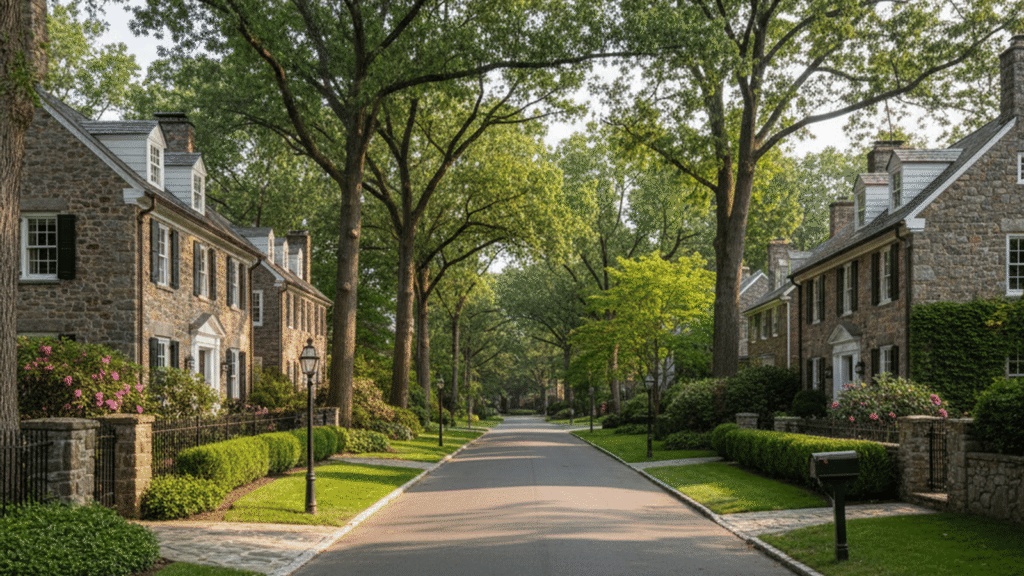
- Historic stone colonials
- Victorian homes
- New construction communities
- Luxury estates
- Mid-century neighborhoods
- Townhomes
- Condominiums
- Horse farms
- Riverfront properties
Each style brings different maintenance requirements, inspection considerations, and long-term ownership costs.
Older homes often offer tremendous character but may require more attention to roofing, electrical systems, plumbing, windows, drainage, and insulation.
Newer homes generally require less immediate maintenance but may lack mature landscaping or walkable town centers.
Neither is objectively better.
They’re simply different ownership experiences.
⸻
What Buyers Often Overlook
After helping numerous relocation clients, I’ve noticed several factors buyers underestimate.
Neighborhood feel.
Natural light.
Noise.
Traffic.
Walkability.
Cell phone service.
Internet availability.
Flood zones.
Future development.
Distance to grocery stores.
Weekend traffic.
These seemingly small details often have a greater impact on long-term happiness than granite countertops or updated bathrooms.
That’s why I encourage buyers to visit neighborhoods at multiple times of day whenever possible.
Morning traffic feels different than Saturday afternoon.
A quiet street at noon may become considerably busier during rush hour.
The more information you gather before making an offer, the more confident you’ll feel after closing.
⸻
The Biggest Mistakes Relocators Make
The most common mistake is shopping exclusively by online rankings.
Websites are useful starting points.
They are not substitutes for experiencing communities firsthand.
Another mistake is focusing entirely on the house while ignoring the neighborhood.
You can renovate a kitchen.
You cannot move a train station.
You cannot create walkability.
You cannot shorten your commute.
Finally, many buyers underestimate how much local knowledge matters.
Two homes may appear nearly identical online while offering completely different ownership experiences because of school assignments, traffic patterns, taxes, municipal services, or neighborhood reputation.
Those nuances rarely appear on listing websites.
⸻
Why Working With a Local Expert Matters
Relocation is different from a traditional move.
You’re not simply comparing houses.
You’re comparing lifestyles.
A local Realtor should help you understand:
- Which towns fit your priorities.
- How commute patterns actually work.
- School district boundaries.
- Local tax differences.
- Neighborhood personalities.
- Market competitiveness.
- Inspection considerations.
- Long-term resale potential.
The right guidance often saves buyers months of frustration and helps them focus on communities that genuinely fit their lives.
⸻
Final Thoughts
The Philadelphia suburbs offer one of the most diverse collections of communities in the country.
Whether you’re drawn to the walkable energy of West Chester, the elegance of the Main Line, the historic charm of Doylestown, the convenience of Montgomery County, the community feel of Delaware County, or the beautiful neighborhoods of South Jersey, there is almost certainly a place that matches your goals.
The key is approaching your search strategically.
Don’t start with a house.
Start with your lifestyle.
Once you know how you want to live, finding the right home becomes dramatically easier.
⸻
By Eric Kelley, Philadelphia Suburbs Realtor & Attorney