
Understanding Property Taxes on the Main Line
What Buyers Need to Know in 2026
Summary
One of the biggest pieces of homework for homebuyers on the Main Line — and one of the most misunderstood — is property taxes. In 2026, taxes remain a central factor in affordability, buyer confidence, and total cost of ownership. Unlike mortgage payments, property taxes are real, recurring, and can vary meaningfully from township to township, even within the same school district. For relocators, move-up buyers, and luxury purchasers alike, understanding property taxes isn’t optional — it’s strategic.
In this guide, we’ll break down how property taxes are calculated on the Main Line, how they compare to nearby regions, why they matter for buyers (and sellers), how tax rates interact with school funding, and what you should absolutely check before making an offer in 2026.
Table of Contents
What Property Taxes Pay For
How Property Taxes Are Calculated on the Main Line
How Tax Rates Vary Across Main Line Townships
Property Taxes vs. School Funding
Comparing Taxes: Main Line vs. Bucks & Chester
Relocation Reality: NYC/DC Buyers and Tax Impact
Why Taxes Matter for Long-Term Value
How Buyers Can Estimate Total Carrying Costs
Common Misconceptions About Main Line Property Taxes
Final Takeaways for 2026 Buyers
1. What Property Taxes Pay For
On the Main Line — as in much of southeastern Pennsylvania — property taxes fund critical public services, including:
Public schools
Local police and fire services
Road maintenance and snow removal
Libraries and parks
Emergency services
Municipal operations
In many cases, higher taxes are directly connected to stronger school systems and community amenities. For families seeking stability and excellent schools, this trade-off is frequently worth it — but informed buyers always run the numbers before committing.
2. How Property Taxes Are Calculated on the Main Line
Property taxes are a function of two primary components:
1. Assessed Value
Each township assesses a property’s value, usually based on recent sales, market conditions, and property characteristics.
2. Millage Rate
This is the tax rate set by local governments, expressed in mills (1 mill = $1 in tax for every $1,000 in assessed value).
Example:
If a home is assessed at $800,000 and the combined millage rate is 30 mills, the annual tax bill would be:
($800,000 ÷ 1,000) × 30 = $24,000
Two different homes with the same market value can have very different property tax bills depending on how each municipality assesses value and sets its mill rate.
3. How Tax Rates Vary Across Main Line Townships
The Main Line is not monolithic — every township has its own approach.
Examples of Typical Patterns (2026 context):
Lower Merion Township (Ardmore, Bryn Mawr):
Higher millage rates
Strong public schools
Premium services and infrastructure
Taxes often reflect the high quality of life
Radnor Township (Wayne, Villanova):
Competitive tax rates given service levels
Radnor Township School District is a major driver of value
Tax bills often more tolerable relative to price
Haverford Township (Haverford, parts of Bryn Mawr):
Moderate taxes
Strong community amenities
Schools perform well
Key Point:
You can be two blocks apart and pay materially different taxes — often because of municipal boundaries, school districts, and local budgets.
4. Property Taxes vs. School Funding
Property taxes are often the largest line item in a buyer’s monthly housing cost — especially on the Main Line — because so much of the revenue goes directly into schools.
Higher school spending often translates to:
Lower student–teacher ratios
Better facilities
More extracurricular offerings
Consistently high test scores
This is why homes in Lower Merion, Radnor, and Haverford Township command price premiums: tax dollars are visibly and consistently reinvested into education.
5. Comparing Taxes: Main Line vs. Bucks & Chester Counties
A common question from relocating buyers is:
Are Main Line property taxes higher than in Bucks or Chester County?
The short answer: It depends on the township and the level of services.
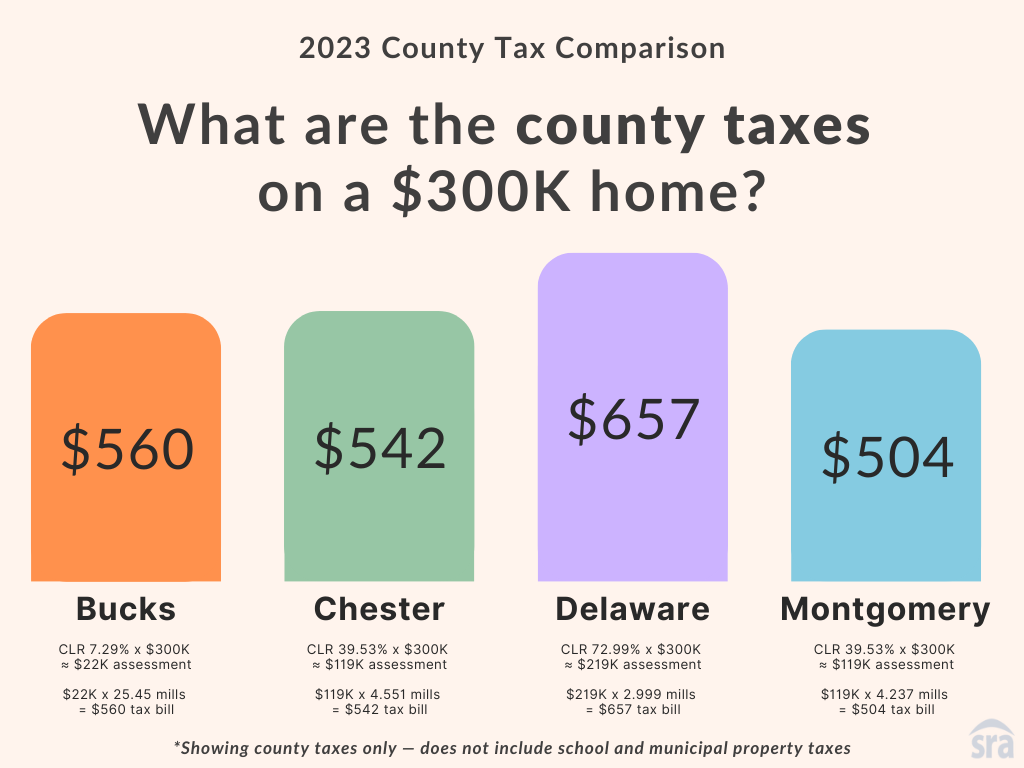
In some Bucks County townships (e.g., parts of Newtown and Doylestown), tax rates can be slightly lower — but they may not offer the same intensity of school funding or municipal services.
In Chester County, taxes vary widely by township. Strong school districts like West Chester Area and Great Valley carry tax rates that rival or exceed Main Line townships — but are frequently balanced by larger parcel sizes and lifestyle differences.
Real insight:
You can’t judge affordability by tax rates alone. You need to look at effective property tax burden, which combines tax rate and assessed value.
6. Relocation Reality: NYC/DC Buyers and Tax Impact
Out-of-state buyers relocating from NYC or Washington, DC often discover an important paradox:
Main Line property taxes may be higher than some PA suburban alternatives
But overall monthly housing costs can still be lower than NYC or DC suburbs when mortgage, insurance, and HOA fees are considered
In other words, while taxes are real, the overall affordability landscape can still be favorable — particularly given school quality and lifestyle benefits.
Relocators should:
Run a total monthly carrying cost comparison
Adjust for tax deductions (where applicable)
Evaluate long-term appreciation, not just upfront costs
7. Why Taxes Matter for Long-Term Value
Property taxes aren’t just a cost — they’re part of the value equation.
Communities that consistently fund schools, infrastructure, and services tend to:
Attract longer-term homeowners
Maintain stable demand
Ride out market cycles better
Retain resale value
Tax levels reflect not just a community’s obligations, but also its priorities.
8. How Buyers Can Estimate Total Carrying Costs
When evaluating a property, buyers should always ask for:
Current tax bill
Assessed value and last reassessment date
Millage rates for every applicable jurisdiction
Expected increases based on recent budgets
You can then calculate:
Yearly Tax Bill = (Assessed Value ÷ 1,000) × Total Millage Rate
Next, add:
Mortgage payment
Insurance
HOA fees (if any)
This gives you a true monthly cost, not just a list price.
9. Common Misconceptions About Main Line Property Taxes
“Main Line taxes are out of control.”
Not universally true. Many buyers see higher bills because home values are higher — not because tax rates are absurd.
“Taxes equal worse affordability.”
Only if you ignore school quality and resale stability. A slightly higher tax bill can represent better long-term value.
“PA taxes are lower than NJ forever.”
Not always. Some NJ suburbs near the Main Line (Medford, Moorestown, Cherry Hill) have competitive effective burdens.
10. Final Takeaways for 2026 Buyers
✔ Property taxes are a real cost — but they are only part of the story.
✔ Main Line taxes often buy premium schools, services, and community stability.
✔ Buyers need to calculate total monthly carrying costs, not just taxes.
✔ Relocators should compare tax burden in context (NYC/DC vs. Philly suburbs).
In 2026, the most informed buyers are those who evaluate tax data strategically, not emotionally.
By Eric Kelley, Philadelphia Suburbs Realtor & Attorney