

Is Now a Good Time to Buy a House in the Philadelphia Suburbs?
A Data-Driven 2026 Outlook
Summary
Many buyers across the Philadelphia suburbs are stuck in the same place:
They want to buy, but they’re afraid they’ll regret it.
High mortgage rates. Headlines about a slowdown. Friends telling them to wait.
But the real question isn’t whether today’s market is “good” or “bad.”
The question is whether waiting actually improves your long-term financial position.
This article breaks down what’s really happening across Chester County, the Main Line, and Bucks County — and why, for many buyers, 2026 may quietly be one of the best buying windows we’ve seen in years.
Table of Contents
The Market Has Shifted — But Not the Way People Think
What Mortgage Rates Are Really Doing to Prices
Inventory, Price Cuts, and Buyer Leverage
Why the Philly Suburbs Behave Differently Than National Housing
The Math of Waiting vs Buying
Who Should Buy in 2026 — And Who Shouldn’t
The Strategic Buyer’s Playbook
1. The Market Has Shifted — But Not the Way People Think
Most people think the housing market moves in simple cycles:
Boom
Bust
Recovery
But the Philadelphia suburbs don’t follow that pattern cleanly.
What has changed is not demand — it’s who can qualify.
Between 2020 and 2022:
Buyers were borrowing at 3%
Payments were cheap
Prices exploded
Between 2023 and 2026:
Buyers are borrowing at 6–7%
Monthly payments are much higher
Prices have flattened, not collapsed
That means buyers today face higher payments but more negotiating power.
This is the core opportunity most people miss.
2. What Mortgage Rates Are Really Doing to Prices
Every 1% increase in mortgage rates cuts buying power by roughly 10%.
That means:
A buyer who could afford $800,000 at 3% can only afford about $600,000–$650,000 at today’s rates.
Sellers can’t ignore that reality.
Across the Main Line, West Chester, and Bucks County, we are seeing:
More price reductions
Longer days on market
Fewer bidding wars
That is not a crash.
That is re-pricing to match affordability.
For buyers, this creates something rare:
Less competition without a flood of distressed sales.
3. Inventory, Price Cuts, and Buyer Leverage
In today’s Philly-suburbs market, you will notice something important:
Homes are still selling — just not instantly.
That gives buyers:
Time to inspect
Time to negotiate
Time to ask for credits
Time to walk away
In 2021, you had none of that.
Sellers who want to move are now:
Paying closing costs
Buying down rates
Accepting inspection credits
Cutting prices
Those concessions often matter more than a lower headline price.
4. Why the Philly Suburbs Behave Differently Than National Housing
Markets like Phoenix, Austin, and parts of Florida are seeing real price drops.
The Philadelphia suburbs are different because:
Job centers are stable
School districts anchor values
There is limited buildable land
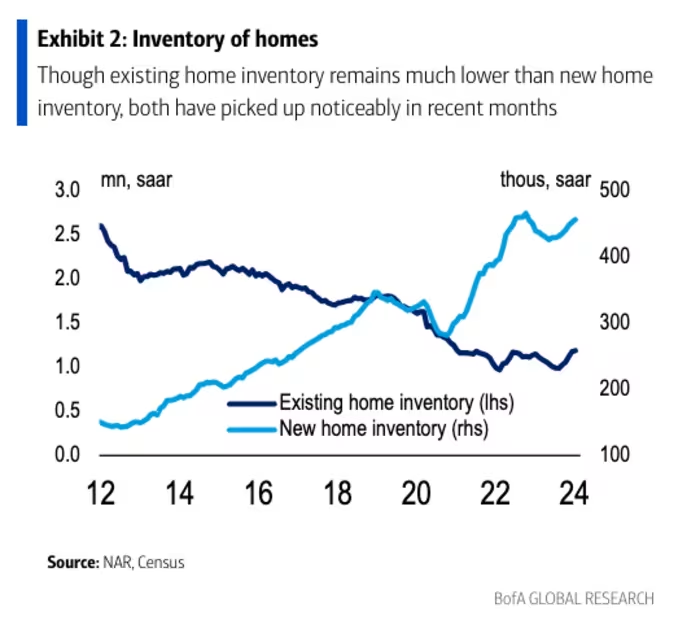
Inventory never fully recovered
Places like Lower Merion, Radnor, Tredyffrin-Easttown, Unionville, and Central Bucks don’t crash easily.
They stagnate — then resume rising.
That is exactly the kind of market buyers should want.
5. The Math of Waiting vs Buying
Here’s the uncomfortable truth:
If you wait for rates to drop, prices will rise.
Why?
Because:
Millions of buyers are on the sidelines
Lower rates instantly bring them back
Inventory will still be limited
So buyers who wait for 5% rates will likely face:
Higher home prices
More competition
Fewer concessions
Buying now lets you:
Negotiate price
Lock in concessions
Refinance later
You can change your rate.
You cannot change what you paid for the house.
6. Who Should Buy in 2026 — And Who Shouldn’t
You should strongly consider buying if:
You plan to stay 5+ years
You want stability
You can comfortably afford today’s payment
You value negotiating power
You should wait if:
You may move soon
Your job is unstable
You need perfect market timing to make the numbers work
This is not about guessing the bottom.
It is about owning in a supply-constrained, high-demand region.
7. The Strategic Buyer’s Playbook
The smartest buyers in the Philly suburbs right now are doing three things:
Buying homes with negotiating leverage
Using seller credits and rate buy-downs
Planning to refinance when rates fall
They are not trying to time the market.
They are trying to out-position everyone else.
That’s how real estate wealth is built.
By Eric Kelley, Philadelphia Suburbs Realtor & Attorney